
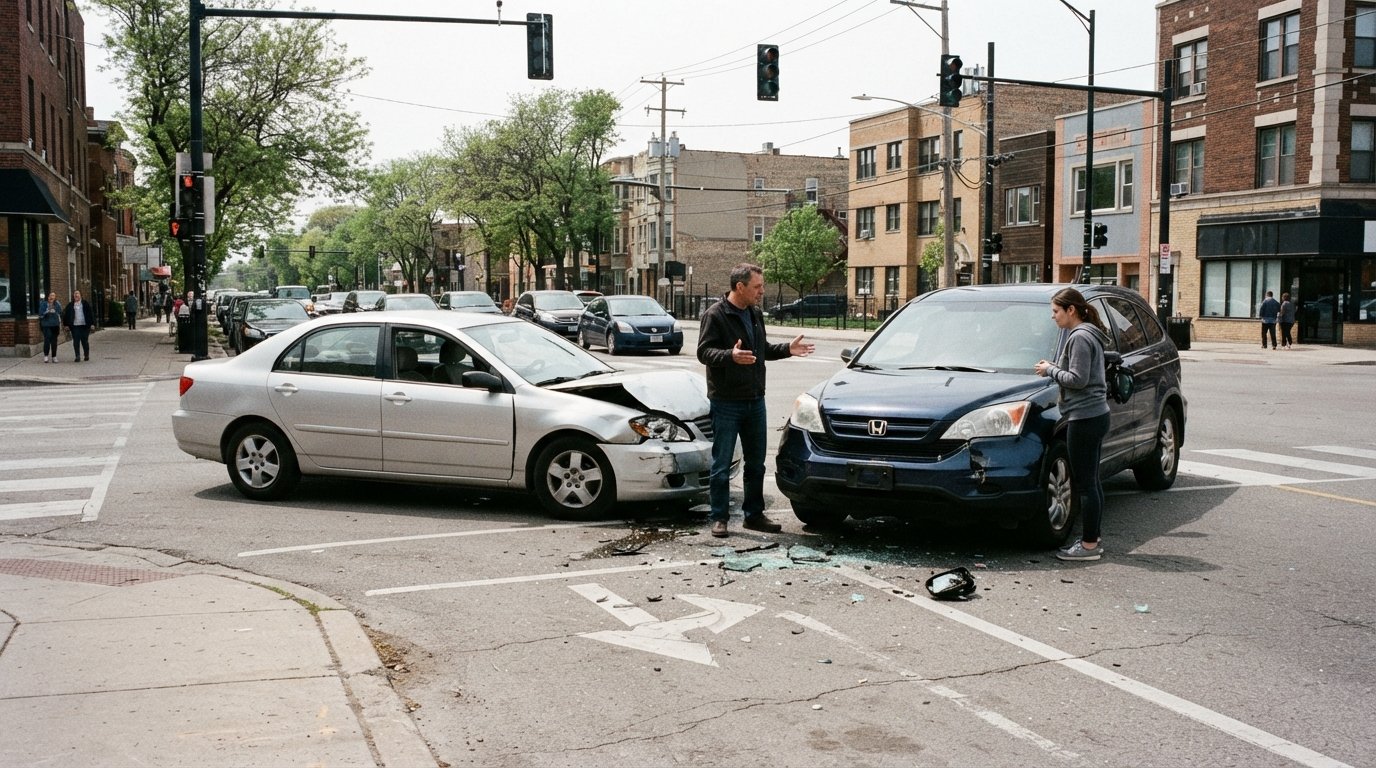
Evidence Needed for a Left Turn Accident Claim
Gather police reports, video, and witness statements to prove right of way. Call (833)-632-1198 for a free case review.

A left turn across oncoming traffic is one of the most dangerous maneuvers on the road. When a crash happens, the turning driver is often presumed at fault, but that presumption is not automatic and it can be challenged. If you were hurt in a left turn collision, or if you are being blamed for one, the evidence you gather in the days and weeks after the crash will largely determine whether you recover fair compensation. This guide explains exactly what evidence you need for a left turn accident claim, how right-of-way rules shape the dispute, and how to build a file that stands up to insurance company scrutiny.
Right-of-Way Rules That Govern Left Turns
Every left turn accident claim begins with a single question: who had the right of way? In the United States, the default rule is that a driver turning left across oncoming traffic must yield to vehicles approaching from the opposite direction. That means the driver making the left turn usually bears the burden of proving the intersection was clear before proceeding. If you were struck by a left-turning vehicle, this rule works in your favor from the start.
But the default rule is not absolute. Several exceptions and complications can shift fault. A left-turning driver may proceed if the oncoming vehicle is far enough away to make the turn safe, if the oncoming driver was speeding, if the oncoming driver ran a red light, or if a police officer or traffic control device directed the turn. Uncontrolled intersections, four-way stops, and intersections with dedicated left-turn arrows each carry their own rules. Your evidence strategy should be built around proving which rule applied and which driver violated it.
This is why documentation matters so much. A police report that simply says "driver A turned left in front of driver B" is a starting point, not a conclusion. Insurers will look for signal timing records, witness accounts, and physical evidence to decide whether the turning driver actually had a safe gap. Gathering that evidence early, before cameras overwrite their footage and skid marks fade, is critical.
Core Evidence for a Left Turn Accident Claim
What evidence do I need for a left turn accident claim? The short answer is everything that helps establish right of way, speed, visibility, and driver conduct at the moment of impact. In practice, strong left turn claims are built from a combination of official records, scene documentation, and witness testimony. The following categories form the backbone of a well-supported claim.
- Police and crash reports: The official report captures officer observations, statements, and any citations issued. A citation for failure to yield is powerful evidence of fault.
- Photographs and video: Scene photos, vehicle damage close-ups, and any dashcam or surveillance footage showing the intersection and signal state.
- Witness statements: Independent witnesses can confirm who had a green light, whether a turn signal was used, and how fast vehicles were moving.
- Medical records: Treatment records link your injuries to the crash and establish the severity of your damages.
- Vehicle and scene data: Skid marks, debris patterns, and damage profiles help reconstruct speed and impact angle.
Each of these items serves a different purpose. The police report frames the official narrative, but it can contain errors or omissions. Photos and video provide objective proof that can override a disputed account. Witness statements fill gaps that cameras miss. Medical records connect liability to damages. Physical evidence such as skid marks can rebut claims that a driver was traveling at a safe speed. Together, they create a record that is difficult for an insurer to dismiss.
Signal Timing, Cameras, and Witness Statements
Left turn disputes frequently come down to the color of the light. Both drivers may sincerely believe they had a green light, and without objective evidence the case can stall. Signal timing records from the local transportation department can show the exact sequence and duration of each phase, including whether a protected left-turn arrow was active. These records are public in most jurisdictions, but they must be requested quickly because retention periods vary.
Intersection cameras and nearby business surveillance are equally valuable. Traffic cameras, red-light cameras, and private security systems often capture the moment of impact. Footage is typically overwritten within days or weeks, so a preservation letter should be sent to the city, the business, and any other custodian as soon as possible. Dashcam footage from either vehicle, or from a nearby driver, can be decisive. Even a short clip showing the signal state or the speed of an oncoming car can settle a disputed claim.
Witness statements add context that cameras cannot. An independent witness can describe whether the turning driver paused, whether a turn signal was activated, and whether the oncoming vehicle appeared to accelerate. Witness contact information should be collected at the scene whenever possible. If witnesses have already left, canvassing nearby businesses and residents can still recover valuable accounts. In disputed cases, an attorney may arrange recorded statements or affidavits to lock in testimony before memories fade.
How Fault Is Disputed When Both Drivers Claim a Green Light
When both drivers insist they had a green light, the claim becomes a battle of corroboration. Insurers will weigh the police report, physical evidence, and witness accounts to decide which version is more credible. A common scenario involves a permissive left turn, where a driver turns on a solid green circle and must yield to oncoming traffic. If the oncoming driver also had a green light, the turning driver is usually at fault for failing to yield, unless the oncoming driver was speeding or ran a red light.
Another scenario involves a protected left-turn arrow. If the arrow was green, oncoming traffic should have been stopped, and a crash suggests the other driver ran a red light. Signal timing records and camera footage become essential in that dispute. A third scenario involves a stale yellow light, where one driver entered the intersection on yellow and the other misjudged the gap. Physical evidence such as skid marks and damage profiles can help reconstruct who entered when.
Because fault disputes can stall a claim for months, it helps to understand how modern claims are evolving. Our guide on how modern accident claims differ in 2026 explains how insurers now use data and technology to evaluate liability, which makes early evidence preservation even more important.
Skid Marks and Vehicle Damage as Proof of Speed
Skid marks, gouges, and debris patterns are physical witnesses that do not change their story. The length and curvature of skid marks can help an accident reconstruction expert estimate pre-impact speed and braking behavior. If the oncoming vehicle left long skid marks, that suggests the driver was moving fast and reacted late. If the turning vehicle left no skid marks, that may indicate the driver never braked before impact. Either way, the physical record supports or undermines the narratives offered by the drivers.
Vehicle damage profiles tell a similar story. The location and depth of damage can indicate impact angle, relative speed, and whether one vehicle was accelerating or braking. A crush pattern concentrated on the front corner of one car and the side of another is consistent with a left-turn collision, but the details matter. Photographs taken before repairs begin are essential, and a professional appraisal or reconstruction report can translate those photos into evidence an insurer will respect.
Scene documentation should also capture road conditions, lighting, weather, and any obstructions to visibility. A sun glare defense, for example, may be rebutted by photos showing the sun's position at the time of the crash. Similarly, a claim that a tree or sign blocked the view can be tested with scene photos and measurements. The more complete the physical record, the harder it is for an insurer to rely on a convenient excuse.
The Impact of Comparative Fault on a Left Turn Claim
Most states apply some form of comparative fault, meaning a victim's recovery is reduced by their own percentage of responsibility. In a left turn case, the turning driver is often assigned the majority of fault, but the oncoming driver may share some responsibility if they were speeding, distracted, or failed to take evasive action. Even a small percentage of fault can reduce a settlement, so it is important to build evidence that minimizes your own contribution.
Comparative fault rules vary by state. Some states follow pure comparative fault, where a victim can recover even if they are mostly at fault, while others follow modified comparative fault, where recovery is barred if the victim's fault exceeds a certain threshold. A handful of states still follow contributory negligence, which can bar recovery entirely if the victim is found even slightly at fault. Knowing which rule applies helps you anticipate how an insurer will evaluate the claim.
Evidence that counters a comparative fault allegation includes dashcam footage showing you had the right of way, witness statements confirming your speed and attention, and physical evidence showing you braked or attempted to avoid the crash. If you were the turning driver, evidence that the other driver was speeding or ran a light can shift fault. In either role, the goal is to control the narrative with objective proof rather than competing recollections.
Steps to Preserve Evidence After a Left Turn Crash
Evidence disappears quickly. Cameras overwrite, skid marks fade, and witnesses move on. The following steps help preserve what matters most in the critical days after a crash.
- Call police and request a report: An official report creates a record and often includes witness statements and citations.
- Photograph everything: Capture the scene, vehicle positions, damage, signals, road conditions, and any visible injuries.
- Collect witness information: Names, phone numbers, and email addresses for anyone who saw the crash.
- Send preservation letters: Request that cameras and signal records be retained before they are overwritten.
- Seek medical treatment and keep records: Consistent treatment documents your injuries and links them to the crash.
These steps are not just administrative. Each one creates a piece of evidence that an insurer or court can rely on. If you are unsure how to request signal timing records or preservation letters, a personal injury attorney can handle those requests and ensure the right deadlines are met. For a free case review, you can also use a service like CheapInjuryLawyer to connect with attorneys who handle left turn accident claims on contingency.
How an Attorney Can Strengthen Your Left Turn Claim
Even with strong evidence, left turn claims can be contested. An experienced attorney can retain accident reconstruction experts, request signal timing records, and take depositions that lock in testimony. They can also evaluate comparative fault exposure and negotiate with insurers who may try to shift blame. Because many personal injury attorneys work on contingency, you do not pay upfront, and fees are typically deducted from a settlement or award.
Attorneys also understand the specific rules in your state, including how comparative fault is applied and what evidence carries the most weight with local courts and insurers. They can identify gaps in the evidence and fill them before the claim is evaluated. If you are unsure what evidence do I need for a left turn accident claim in your specific situation, a consultation can clarify the strongest path forward.
The most important takeaway is that evidence wins left turn cases. Right-of-way rules create a framework, but the outcome depends on proof. By gathering police reports, photos, video, witness statements, signal records, and physical evidence early, you give yourself the best chance at a fair recovery. Whether you were the turning driver or the oncoming driver, control the narrative with facts, and do not let the other side define the story.