
How Accident Reconstruction Diagrams Are Created

When a serious car crash leaves behind conflicting stories and shattered vehicles, the truth often hides in the physical evidence. Accident reconstruction diagrams bridge that gap, turning skid marks, vehicle damage, and road geometry into a visual story that juries, insurers, and attorneys can understand. These precise drawings do more than show where cars ended up; they explain how the collision happened, who had the right of way, and why the impact occurred with such force. For anyone involved in a personal injury claim, understanding how accident reconstruction diagrams are created can mean the difference between a denied claim and a fair settlement.
The Purpose of an Accident Reconstruction Diagram
An accident reconstruction diagram is a scaled, technical drawing that maps the sequence of events before, during, and after a vehicle collision. It serves as a visual anchor for expert testimony, helping judges and juries grasp complex dynamics like vehicle speed, angle of impact, and reaction times. Unlike a simple police sketch, these diagrams are built on mathematical models and physical evidence collected at the scene, making them powerful tools for establishing liability.
In legal proceedings, the diagram often becomes the centerpiece of an expert witness’s presentation. It allows the reconstructionist to walk the court through the crash step by step, from the first tire impression to the final resting position. For insurance adjusters, these diagrams provide an objective basis for evaluating fault, which directly impacts claim payouts. Without a reliable diagram, a case can devolve into he-said-she-said disputes, leaving victims without the compensation they deserve.
The Role of the Reconstruction Expert
Creating an accurate diagram requires more than drafting skills; it demands a deep understanding of physics, vehicle dynamics, and forensic science. Reconstruction experts typically hold backgrounds in engineering, accident investigation, or law enforcement, and many are certified by professional organizations such as the Accreditation Commission for Traffic Accident Reconstruction (ACTAR). Their work begins long before the first line is drawn, starting with a meticulous examination of the crash site and the vehicles involved.
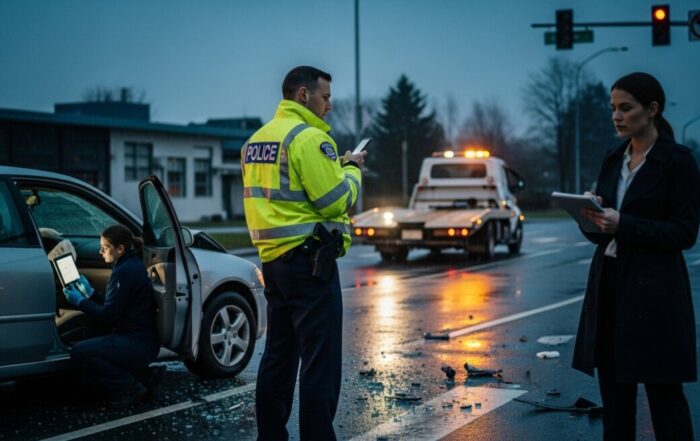
These professionals gather data from multiple sources, including police reports, witness statements, and vehicle black boxes. They also measure tire marks, evaluate road conditions, and photograph every angle of the damage. The goal is to create a model that aligns with all available evidence, eliminating improbable scenarios and narrowing the case to the most likely sequence of events. This process is both scientific and investigative, requiring patience and precision at every stage.
In our guide on what accident reconstruction experts actually do, we break down the daily tasks and methodologies these specialists use to build their cases. Understanding this expertise is crucial when you are evaluating your own claim, because the quality of the reconstruction can heavily influence how insurers and courts view your case.
Key Data Sources Used in Reconstruction
Before a single line is placed on paper, the reconstructionist must collect and verify a wide range of data. The accuracy of the final diagram depends entirely on the quality of this evidence. Common sources include:
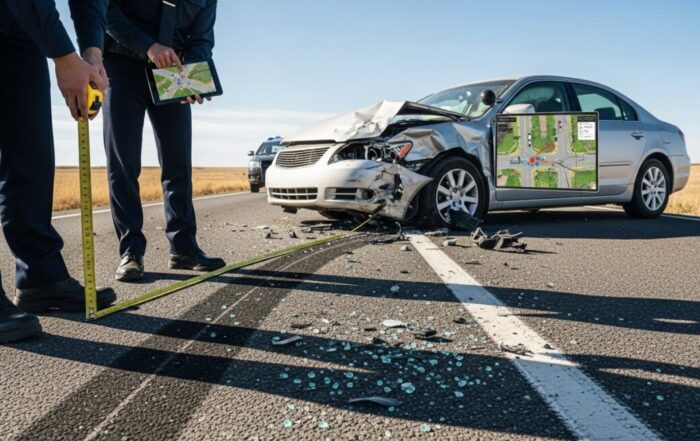
- Physical evidence at the scene: skid marks, yaw marks, debris, glass, and fluid stains that indicate vehicle paths and impact points.
- Vehicle damage analysis: crush patterns, wheel alignment, and deployed airbags that reveal speed and force at impact.
- Electronic data recorders (EDRs): the “black box” in vehicles that captures pre-crash speed, braking, and steering inputs.
- Witness and driver statements: accounts that provide context for how the vehicles behaved before the collision.
- Photographic evidence: scene photos, drone footage, and surveillance video that help confirm measurements and details.
Each source contributes a piece to the puzzle, and the expert must weigh the reliability of each. For instance, skid marks can be misleading on wet roads, and witness recollections often conflict with physical evidence. The reconstructionist’s job is to synthesize these inputs into a coherent timeline that withstands cross-examination.
Step-by-Step Process of Creating a Diagram
Creating an accident reconstruction diagram is a multi-stage process that combines field work, computer modeling, and rigorous verification. While each case is unique, most reconstructions follow a similar sequence. Here are the key steps:
- Scene documentation: Survey the site using total stations, laser scanners, or photogrammetry to capture precise measurements of road features, tire marks, and final vehicle positions.
- Data collection and analysis: Gather evidence from vehicles, EDRs, and witnesses, then analyze it to estimate speeds, angles, and timing.
- Computer modeling: Import the measurements into specialized software that can simulate the crash dynamics and test different scenarios.
- Diagram drafting: Create a scaled, clear drawing that shows the roadway, vehicles, and evidence markers, often using CAD (computer-aided design) tools.
- Verification and refinement: Compare the model against physical evidence and peer-reviewed data, adjusting the diagram until it accurately reflects the most probable event sequence.
This process is iterative, and experts often revisit earlier steps as new evidence emerges. For a straightforward rear-end collision, the diagram might be completed in a few days. For a complex multi-vehicle pileup, the work can take weeks or even months, especially if additional testing like crash recreations is required.
Common Tools and Software Used
Modern reconstruction relies heavily on advanced technology that increases accuracy and reduces human error. Total stations measure distances and angles with millimeter precision, while 3D laser scanners capture millions of points to create a digital twin of the crash scene. Photogrammetry uses overlapping photographs to reconstruct geometry without physically touching the evidence, which is invaluable when the scene has been cleared.
For the actual diagram, software like FARO Zone, PC-Crash, and Virtual CRASH are industry standards. These programs allow experts to import measurements, build scaled models, and run simulated trajectories. They also generate intuitive visuals that can be animated for courtroom presentations, making complex physics understandable for laypeople. The choice of software often depends on the expert’s training and the specific needs of the case, but all produce diagrams that meet legal standards for admissibility.
Ensuring Accuracy and Legal Admissibility
An accident reconstruction diagram is only useful if it is legally admissible in court. That means the expert must follow recognized methodologies and document every step of the process. The diagram must be based on reliable data, and the expert must be able to explain how they derived each measurement and conclusion. Legal challenges often focus on the expert’s qualifications, the validity of the data, and whether the methodology is generally accepted in the scientific community.
To meet these standards, experts maintain detailed files that include raw measurements, calibration records, and the software settings used to create the diagram. They also prepare reports that summarize their findings and the reasoning behind them. In many cases, the expert will testify about the diagram’s creation, walking the court through the evidence and the logic that led to the final depiction. This level of transparency helps establish credibility and withstands scrutiny from opposing counsel.
How Diagrams Impact Personal Injury Claims
For injury victims, these diagrams can be the linchpin of a successful claim. A well-crafted reconstruction can prove that the other driver was speeding, that they failed to yield, or that a mechanical defect caused the crash. This evidence often pressures insurance companies to settle for higher amounts, because they know a jury is likely to side with the victim. Conversely, a weak or missing diagram can leave the claim vulnerable to disputes, delays, and reduced offers.
If you are pursuing a car accident claim, having an attorney who can commission and interpret a reconstruction diagram is essential. Attorneys know which experts to hire, how to present the diagram to insurers, and how to challenge opposing reconstructions. They also understand the legal standards for admissibility, ensuring that the diagram is used effectively in negotiations or at trial. Without this professional support, you may struggle to turn technical evidence into a compelling case.
Frequently Asked Questions
How long does it take to create an accident reconstruction diagram?
The timeline varies based on case complexity, the amount of evidence, and the expert’s workload. Simple cases may take a few days, while intricate multi-vehicle accidents can take several weeks. The expert must allow time for data collection, analysis, and verification, so it is wise to involve them early in the claim process.
Can a reconstruction diagram be created without visiting the scene?
Yes, in some cases, experts can use photographs, drone footage, and police measurements to create a diagram. However, a site visit is always preferable because it allows for direct measurement and observation of features like road slope and sight lines that photos may miss. If the scene has changed, early documentation becomes even more critical.
Are reconstruction diagrams always admissible in court?
They are often admitted, but not automatically. The court will assess the expert’s qualifications, the reliability of the methodology, and whether the diagram is more probative than prejudicial. A well-prepared diagram from a qualified expert is generally accepted, but opposing counsel can attempt to exclude it if there are flaws in the data or analysis.
Why You Need a Legal Partner Who Understands Reconstruction
Navigating a personal injury claim after a serious accident is stressful, especially when you are dealing with medical bills, lost wages, and insurance adjusters. The technical world of accident reconstruction can feel overwhelming, but you do not have to face it alone. An experienced attorney can coordinate with reconstruction experts, ensure the diagram is created correctly, and use it to build a powerful case on your behalf.
At LawyerOffer, we connect injury victims with attorneys who have the resources and knowledge to handle complex accident claims. Our referral service is designed to help you find legal representation that will fight for your rights. If you believe a reconstruction diagram could strengthen your claim, let us help you take the next step. Call us today at (833) 227-7919 to speak with a specialist about your case.
Understanding how accident reconstruction diagrams are created gives you an important advantage in your claim. It allows you to ask the right questions, recognize strong evidence, and work effectively with your legal team. With the right support, you can turn a confusing collision into a clear, compelling narrative that secures the compensation you deserve.

About Michael Turner
Recent Posts
How Speed Is Proven After a Crash: Key Evidence
Learn how speeding is proven after an accident using EDR data, skid marks, and video. Call (833) 227-7919 for a free attorney referral.
How Texting Evidence Is Used in Accident Cases
Discover how texting evidence is used in accident cases to prove fault and win claims. Call (833) 227-7919 for a free case review.

How Texting Evidence Is Used in Accident Cases
Learn how texting evidence is used in accident cases and how it can prove fault or challenge claims. Call (833) 227-7919 for a free attorney referral.