
How Speed Is Proven After a Crash: Key Evidence
When a car accident leaves you injured and your vehicle crumpled, one of the first questions that surfaces is whether the other driver was speeding. Speed is a factor in roughly one-third of all fatal crashes, yet proving it after the fact is rarely straightforward. Unlike a skid mark or a broken headlight, speed leaves no single smoking gun. Instead, investigators and attorneys must piece together physical evidence, electronic data, and witness accounts to establish how fast a vehicle was actually traveling. Understanding how speeding is proven after accident can mean the difference between a denied claim and a settlement that covers your medical bills, lost wages, and pain and suffering.
If you are pursuing a personal injury claim, the burden of proof rests on you. That means you need to show, by a preponderance of the evidence, that the other driver’s excessive speed caused or contributed to the collision. Insurers and defense lawyers will not simply take your word for it. They will scrutinize every piece of data, from tire marks to airbag modules. This article walks you through the most reliable methods used to prove speed, the challenges you may face, and how a skilled attorney can use this evidence to build a strong case. If you are dealing with the aftermath of a crash, knowing what evidence matters can help you preserve it before it disappears.
Why Speed Is So Hard to Prove
Speed is a measure of motion, and motion leaves traces, but those traces are often subtle or degraded. A driver may admit to going “a little over the limit,” but that admission rarely translates into a precise number. Witnesses may estimate a car was “going fast,” yet human perception of speed is notoriously unreliable, especially in the split seconds before impact. Without corroborating physical evidence, a vague estimate does little to persuade an insurance adjuster or a jury.
Another complication is that modern vehicles are designed to crumple and absorb energy. The damage to a car does not always correspond neatly to impact speed, because the forces are dissipated through the vehicle’s structure. Two crashes at the same speed can produce very different damage patterns depending on the angle of impact, the weight of the vehicles, and the surfaces involved. For these reasons, investigators rely on a combination of methods to build a credible speed estimate.
Physical Evidence at the Scene
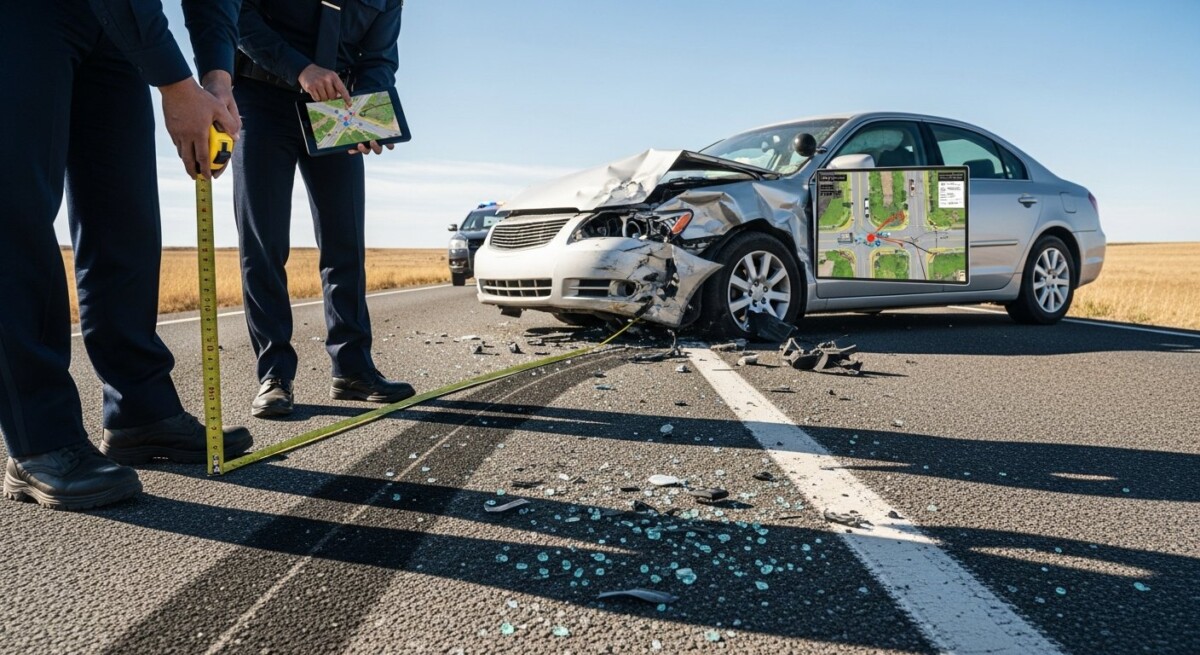
The most direct evidence of speed often comes from the physical marks left on the road. Skid marks, for example, are created when a driver brakes hard and the tires lock up. The length of those marks, combined with a known coefficient of friction for the road surface, allows accident reconstructionists to calculate a minimum speed at the moment braking began. However, skid marks are not always present. Anti-lock braking systems (ABS) prevent wheel lockup, leaving behind fainter tire scrubbing marks that are harder to measure. In wet conditions, marks may wash away quickly.
Other physical clues include yaw marks, which indicate a vehicle was sliding sideways, and gouge marks or debris patterns that show where the impact occurred and how far vehicles traveled after the collision. The final resting positions of the vehicles, along with the distance they moved post-impact, can be used to estimate impact speed using principles of conservation of momentum. This is where the expertise of a crash reconstructionist becomes invaluable.
Here are the most common physical evidence types used to prove speed:
- Skid marks and tire scrub: Length and pattern help calculate pre-braking speed.
- Yaw marks: Curved tire marks indicate loss of control and lateral speed.
- Gouges and scrapes: Point of impact and direction of force.
- Debris field: Distance and spread of shattered glass or plastic can indicate impact force.
- Vehicle deformation: Crush depth and pattern correlate with speed and angle.
Each piece of evidence on its own may be inconclusive, but when combined, they can paint a detailed picture. For example, a reconstructionist might use skid marks to estimate a minimum speed of 55 mph in a 35 mph zone, then cross-check that with the vehicle’s crush damage and post-impact movement. This triangulation strengthens the speed estimate and makes it harder for the defense to dispute.
Event Data Recorders: The Car’s Black Box
Most vehicles manufactured after 2013 are equipped with an event data recorder (EDR), commonly known as a black box. This device continuously records data from the seconds leading up to a crash, including vehicle speed, throttle position, brake application, steering angle, and seatbelt use. The EDR can provide the most precise speed estimate available, often within a few miles per hour of the actual speed at impact.
Accessing EDR data is not always simple. The data is stored on the airbag control module, and only certain professionals have the tools and software to retrieve it. Law enforcement may download the data if they suspect a serious violation, but in many cases, the information remains in the vehicle until an attorney or a reconstructionist requests it. If your car is towed to a salvage yard or impound lot, the data can be lost or overwritten if the vehicle is repaired or scrapped. That is why it is critical to secure the vehicle and preserve the EDR data as soon as possible after the crash.
In some cases, the EDR data can be used against you if you were also speeding. However, if the other driver was at fault, the EDR is a powerful tool. It can confirm that the other vehicle was traveling at 70 mph in a 45 mph zone just before the collision, leaving little room for argument. For a deeper look at how electronic evidence is handled in accident cases, see our guide on how video evidence strengthens accident claims.
Dashcam and Surveillance Footage
Video footage can be the most persuasive form of speed evidence because it shows the actual movement of the vehicles. A dashcam in your own car may capture the other vehicle approaching at high speed, while surveillance cameras from nearby businesses, traffic lights, or red-light cameras can provide an independent view. Even a smartphone video taken by a bystander can be helpful, though its quality and angle may limit its usefulness.
To use video effectively, investigators often perform a process called photogrammetry. They calibrate the video using known distances in the frame, such as lane markings or the length of a car, then track the vehicle’s position across multiple frames. This allows them to calculate its speed in miles per hour. This method is not exact, but it can corroborate other evidence or expose discrepancies in a driver’s story.
If you have a dashcam, preserve the original footage immediately. Do not edit or compress the file, because that can raise questions about authenticity. Also, check with nearby businesses to see if their security cameras captured the crash. Store owners are often willing to share footage with law enforcement or an attorney, but they may overwrite recordings after a few days. Acting quickly is essential.
Witness Testimony and Admissions
While physical and electronic evidence is more reliable, witness testimony can still play a role. A witness who saw the other vehicle weaving through traffic at a high rate of speed, or who heard the engine revving before impact, can provide valuable context. However, witnesses often overestimate speed, especially when a crash is sudden or dramatic. An experienced attorney will know how to question witnesses to elicit useful details without giving the defense an opportunity to undermine their credibility.
Admissions by the at-fault driver can also be used as evidence. If the driver texted a friend saying “I was going 80 and lost control,” that message could be retrieved from their phone during discovery. Similarly, if the driver made a statement to the police at the scene, that statement can be used against them later. Even statements to an insurance adjuster, if they are recorded, may be admissible. Your attorney can help you identify and preserve these admissions.
Cross-examination of the at-fault driver is another avenue. During a deposition or trial, a skilled attorney can walk the driver through the physical evidence and force them to reconcile their version of events with the data. For instance, if the driver claims they were going 35 mph but the EDR shows 60 mph, the contradiction becomes stark. To understand how these tactics play out in court, review our analysis of how cross examination works in accident trials.
The Role of Accident Reconstruction Experts
When speed is a central issue, both sides often hire accident reconstruction experts. These professionals have backgrounds in engineering, physics, and law enforcement. They analyze the physical evidence, vehicle damage, and electronic data to produce a scientific estimate of speed and impact forces. Their reports are often used to support a settlement negotiation or to present to a jury.
Reconstruction experts use specialized software to simulate the crash. They input data such as vehicle weights, coefficients of friction, and occupant kinematics to determine how fast the vehicles were moving at various points in the sequence. They can also determine the point of impact and the angle of approach, which is crucial for understanding who had the right of way.
Hiring an expert is not cheap, but it is often necessary to prove speed convincingly. In many personal injury cases, the potential settlement or verdict is large enough to justify the cost. Your attorney can help you decide whether an expert is needed and can recommend a qualified professional. If the other side hires an expert, your attorney will need to challenge their methodology and conclusions, which is another reason to have your own expert review the evidence.
Legal Consequences of Proven Speeding
Proving that the other driver was speeding does more than just establish fault. It can also affect the types of damages you can recover. In many states, speeding is considered negligence per se if the driver violated a traffic law that was designed to prevent the type of harm that occurred. This means the court may presume the driver was negligent, which simplifies your burden of proof.
Speeding can also be a factor in punitive damages. If the driver was traveling at an extreme speed, such as double the limit, or was racing another vehicle, a jury may award punitive damages to punish the driver and deter similar behavior. These damages are in addition to compensatory damages for your medical bills, lost income, and pain and suffering. However, punitive damages are not available in every case, and they require clear and convincing evidence of reckless disregard for safety.
On the flip side, if you were also speeding, the defense may argue comparative negligence. Under this doctrine, your own fault reduces your recovery proportionally. For example, if you were going 10 mph over the limit and the other driver was going 20 mph over, a jury might assign you 30% of the fault, reducing your award by 30%. This is why it is crucial to have accurate speed data for all vehicles involved, not just the other driver.
How an Attorney Can Help You Prove Speeding
Given the technical nature of speed evidence, you need an attorney who understands how to gather and present it effectively. After a crash, an attorney can issue a spoliation letter to the at-fault driver and their insurance company, demanding that they preserve all evidence, including EDR data, maintenance records, and any video footage. The attorney can also subpoena traffic camera footage and phone records if texting while driving is suspected.
Your attorney will also interview witnesses, hire an accident reconstructionist if necessary, and negotiate with the insurance company. Insurance adjusters are trained to minimize payouts, and they may downplay the role of speed or argue that the evidence is inconclusive. An experienced attorney can counter these arguments with a well-documented case. To see how insurers often try to shift blame, read about defense lawyer tactics in accident cases exposed.
If your case goes to trial, your attorney will present the speed evidence in a clear, convincing manner, often using animations or diagrams to help the jury understand complex concepts. The goal is to show that the other driver’s speed directly caused the crash and your injuries. Without an attorney, you risk losing the case or accepting a lowball settlement.
Preserving Evidence After Your Crash
What you do in the days after a crash can make or break your ability to prove speeding. First, call the police and ensure a report is filed. The officer may note skid marks, vehicle damage, and witness statements. These notes can be invaluable later. Second, take photos of the scene from multiple angles, including the vehicles, the road conditions, and any visible marks. If you have a smartphone, use it to record a video as well. Third, seek medical attention even if you feel fine, as some injuries take days to appear, and prompt treatment documents your injuries.
Next, notify your insurance company, but be careful what you say. Stick to the facts and do not speculate about speed. Anything you say to your insurer can be used against you later. Finally, contact an attorney before discussing the case with the other driver’s insurance company. They may try to get you to make a recorded statement or sign a release, which can waive your rights.
If you are concerned about the cost of hiring a lawyer, many personal injury attorneys work on a contingency fee basis. That means they only get paid if you win your case, so there is no upfront cost to you. This arrangement allows you to pursue a claim without financial risk. If you want to understand the process of proving other types of injuries, our article on how nerve damage claims are proven in court offers a parallel look at medical evidence.
Frequently Asked Questions
Can the police determine speed from skid marks alone?
Skid marks can provide a minimum speed estimate, but they are not sufficient on their own. The length of the marks, the road surface, and the vehicle’s weight are factored into a calculation that yields a speed range. An accident reconstructionist is usually needed to interpret this data accurately.
Is EDR data always accurate?
EDR data is generally reliable, but it is not infallible. The system may record data only if the crash meets certain criteria, such as a sudden deceleration. Also, if the vehicle was involved in a previous crash, the data may be overwritten. That is why it is important to preserve the vehicle and retrieve the data quickly.
What if the at-fault driver’s car does not have an EDR?
Older vehicles may not have an EDR. In that case, investigators rely on physical evidence, video footage, and witness testimony. A reconstructionist can still estimate speed with reasonable accuracy using these other methods.
How long do I have to file a claim after a speeding-related accident?
Each state has a statute of limitations for personal injury claims, typically ranging from one to six years. It is important to act quickly, because evidence can be lost and witnesses’ memories fade. An attorney can help you understand the deadline in your state.
Will my insurance rates go up if I prove the other driver was speeding?
If you are not at fault, your rates should not increase, although some insurers still raise rates after any claim. Proving the other driver’s speed can help establish fault and protect you from rate hikes.
Proving speed after an accident is a complex process that requires a combination of evidence and expertise. Whether you rely on skid marks, EDR data, or video footage, the goal is to create a clear, credible picture of what happened. If you have been injured in a crash where speeding may have played a role, do not wait. The sooner you preserve evidence and consult an attorney, the stronger your case will be.
At LawyerOffer, we connect you with attorneys who have the experience to handle speeding-related accident claims. Our referral service is free, and there is no obligation to hire a lawyer. Call us at (833) 227-7919 to discuss your case with a qualified professional. We are here to help you understand your rights and get the compensation you deserve.

About Katerin Solace
Recent Posts
How Speed Is Proven After a Crash: Key Evidence
Learn how speeding is proven after an accident using EDR data, skid marks, and video. Call (833) 227-7919 for a free attorney referral.
How Texting Evidence Is Used in Accident Cases
Discover how texting evidence is used in accident cases to prove fault and win claims. Call (833) 227-7919 for a free case review.
How Texting Evidence Is Used in Accident Cases
Learn how texting evidence is used in accident cases and how it can prove fault or challenge claims. Call (833) 227-7919 for a free attorney referral.