
How Insurers Assign Fault Percentages Internally

After a car accident, one of the most critical factors determining your compensation is the percentage of fault assigned to you. This number, often calculated behind closed doors, directly impacts your settlement. Understanding how insurers assign fault percentages internally can help you anticipate their moves and protect your financial recovery. Insurance companies use a combination of state laws, police reports, and internal guidelines to build these percentages, but the process is far from transparent. By knowing exactly how adjusters think, you can challenge unfair determinations and ensure you are not left paying for someone else’s mistake.
The Legal Foundation: Pure vs. Modified Comparative Negligence
Before any adjuster picks up a file, they look at the state law governing the accident. Fault percentages are not arbitrary; they must align with the legal framework of the state where the crash occurred. Two primary systems dominate the United States: pure comparative negligence and modified comparative negligence. In a pure comparative negligence state, you can recover damages even if you are 99 percent at fault, though your award is reduced by your percentage of fault. For example, if your damages total $100,000 and you are 80 percent at fault, you can still recover $20,000. In a modified comparative negligence state, there is a threshold, usually 50 or 51 percent. If your fault percentage meets or exceeds that threshold, you recover nothing.
Adjusters internalize these rules immediately. They know that a 49 percent fault assignment in a 50 percent bar state is the maximum they can assign without completely eliminating your claim. This creates a strategic incentive for insurers to push your percentage just under that bar to reduce their payout, or just over it to deny the claim entirely. This is why understanding your state’s specific law is the first step in evaluating any fault determination. The insurer’s internal training manuals often emphasize these thresholds because a single percentage point can mean the difference between a settlement and a denial.
The Evidence Adjusters Weigh Most Heavily
When determining liability, insurance adjusters rely on a hierarchy of evidence. The most persuasive piece is typically the police report, especially the responding officer’s narrative and any citations issued. Adjusters treat a citation for a moving violation as a strong indicator of fault. However, they also know that police reports are not always conclusive. Officers may not witness the accident, and their opinions are based on witness statements and physical evidence at the scene. Therefore, adjusters cross-reference the police report with other sources to build their internal case file.
Beyond the police report, adjusters scrutinize the following types of evidence in order of importance:
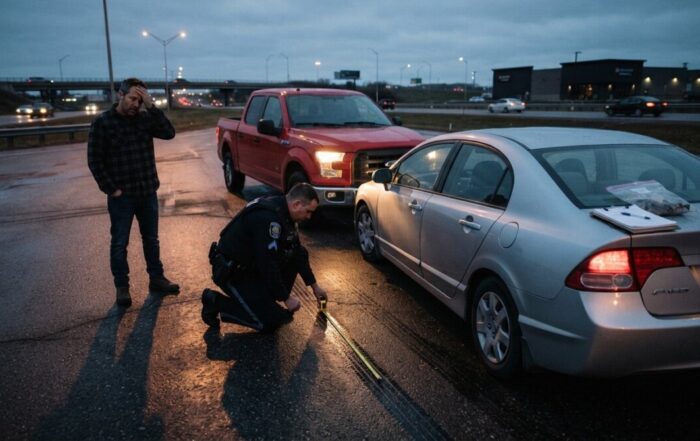
- Photographs and video footage: Images of vehicle damage, skid marks, debris fields, and traffic camera or dashcam footage provide objective data. A photo showing your car entirely in the wrong lane is difficult to argue against.
- Witness statements: Independent witnesses who have no stake in the outcome carry significant weight. Adjusters will interview them over the phone and record their accounts. Statements from friends or family members are often discounted as biased.
- Inconsistent statements: If you change your story between the scene, the hospital, and the recorded statement, the adjuster will use that inconsistency to argue that you are unreliable or partially at fault.
Each piece of evidence is assigned a weight in the adjuster’s internal worksheet. Physical evidence like skid marks and impact angles often overrides witness testimony because physics is harder to dispute. This means that even if a witness says you had a green light, but the damage pattern suggests you were speeding, the adjuster may assign you a higher percentage of fault based on the physics of the crash. Understanding this hierarchy allows you to gather the right evidence early, before the adjuster locks in their initial determination.
Internal Guidelines and the “Pure Comparative” Matrix
Insurance companies rely on proprietary software and internal guidelines to standardize fault percentages across similar accident scenarios. These systems are not public, but they follow predictable patterns. For example, a rear-end collision typically assigns 100 percent fault to the rear driver unless the lead driver backed up or had malfunctioning brake lights. A left-turn accident usually assigns 100 percent fault to the turning driver. However, adjusters have discretion to adjust these baselines based on mitigating factors such as weather, road conditions, or sudden mechanical failure.
Adjusters use a matrix that considers both primary and secondary factors. Primary factors include the type of collision, point of impact, and violation of traffic laws. Secondary factors include visibility, speed, and distracted driving allegations. The matrix produces a preliminary fault percentage, which the adjuster then reviews against state law. This internal process is designed to create consistency, but it also allows for subtle manipulation. An adjuster might increase your fault percentage by five or ten percent based on a subjective assessment of your cooperation level or the clarity of your answers during a recorded statement.
This is where the human element becomes critical. The adjuster’s goal is to minimize the insurer’s payout while avoiding a lawsuit. If you present a clear, consistent, and well-documented case, the adjuster has less room to assign you an inflated percentage. Conversely, if you seem confused or uncooperative, the adjuster may feel justified in giving you a higher share of the blame. The internal guidelines are a starting point, not a final verdict, and your ability to challenge them depends on the strength of your evidence and your legal representation.
How Adjusters Calculate the Dollar Impact of Fault
Once the fault percentage is established, the adjuster applies it to the total damages. This calculation is straightforward in theory but complex in practice. Total damages include medical expenses, lost wages, property damage, and pain and suffering. The adjuster multiplies the total by your percentage of fault and subtracts that amount from the settlement. For example, if your total damages are $50,000 and you are 30 percent at fault, the insurer offers $35,000. However, adjusters often undervalue pain and suffering to further reduce the payout, even before applying the fault percentage.
Adjusters also consider the policy limits of both drivers. If the at-fault driver has minimal coverage, the adjuster may assign a higher fault percentage to you to force your own underinsured motorist coverage to pay. This is a common tactic in low-coverage states. The adjuster knows that if they assign you 51 percent fault in a modified comparative state, they can deny your claim entirely, forcing you to rely on your own collision coverage and pay your deductible. Understanding this dynamic is crucial for protecting your financial interests. In our guide on claiming insurance when partially at fault, we explain how to navigate these tactics and maximize your recovery despite a shared liability determination.
Strategies to Challenge an Unfair Fault Percentage
If you receive a fault determination that seems inflated or unjust, you have several options to challenge it. The first step is to request a copy of the adjuster’s file, including the evidence they used to reach their conclusion. Many insurers will provide this upon request, especially if you have an attorney. Review the evidence for gaps, inconsistencies, or overreliance on subjective factors. For example, if the adjuster cited a witness statement that contradicts the physical evidence, you can highlight that discrepancy.
Next, gather your own evidence to counter the adjuster’s narrative. This can include independent witness statements, traffic camera footage, or a reconstruction expert’s analysis. Present this evidence in a clear, organized manner to the adjuster, along with a written explanation of why their fault percentage is incorrect. If the adjuster refuses to budge, you can escalate the dispute to a supervisor or file a complaint with your state’s insurance commissioner. In many cases, the threat of a formal complaint or a lawsuit is enough to make the insurer reconsider their position.
Finally, consider hiring an attorney who specializes in accident claims. An experienced lawyer knows the internal playbook of major insurers and can negotiate from a position of strength. They can also handle the complexities of navigating no-fault insurance claims if your state operates under that system. Legal representation changes the dynamics of fault negotiations because adjusters know that attorneys are more likely to file a lawsuit if a fair settlement is not reached. This pressure often results in a more reasonable fault percentage and a higher overall settlement.
Frequently Asked Questions
Can an insurance company change my fault percentage after I accept a settlement?
Once you sign a settlement agreement, the fault percentage is generally final. You cannot later reopen the claim to argue for a different percentage unless there is evidence of fraud or a mutual mistake. This is why you should never accept a settlement without fully understanding how the fault percentage was calculated.
Do insurers share fault percentages with each other?
Yes, through databases like the Comprehensive Loss Underwriting Exchange (CLUE). If one insurer determines you were 40 percent at fault in an accident, that information can be accessed by other insurers when you apply for new coverage or file a future claim. This can affect your premiums, so it is worth challenging an unfair determination even for a minor accident.
What happens if both drivers disagree with the fault percentage?
When both parties dispute the fault assignment, the case typically goes to arbitration or court. A neutral third party reviews the evidence and makes a binding determination. This process can be lengthy and expensive, which is why insurers often try to settle at an intermediate percentage rather than litigate.
Protecting Your Recovery Through Knowledge
Understanding how insurers assign fault percentages internally gives you a significant advantage in the claims process. You are no longer a passive participant waiting for a decision. Instead, you can actively gather the right evidence, challenge biased assumptions, and negotiate from a position of informed strength. The key is to act quickly after an accident. Preserve photographs, obtain witness contact information, and seek medical attention immediately. Every delay gives the adjuster more room to build a case against you.
If you feel overwhelmed by the complexity of fault negotiations, remember that you do not have to face this process alone. Legal resources are available to help you level the playing field. At LawyerOffer, we connect you with experienced attorneys who understand the internal tactics of insurance companies. Call us at (833) 227-7919 for a free consultation. With the right representation, you can ensure that the fault percentage assigned to you reflects the facts of the accident, not the adjuster’s desire to minimize their payout.

About Elira Vaughn
Recent Posts

How No Fault Insurance Systems Work: Key Facts
Learn how no fault insurance systems work and get help with your claim. Call (833) 227-7919 for a free case review.
How Comparative Negligence Laws Differ by State
Understand how comparative negligence laws differ by state and protect your settlement. Call (833) 227-7919 for a free case review.

Why State Laws Differ in Accident Cases and What That Means for You
Understand how state laws differ in accident cases and protect your claim. Call (833) 227-7919 for a free attorney referral.