
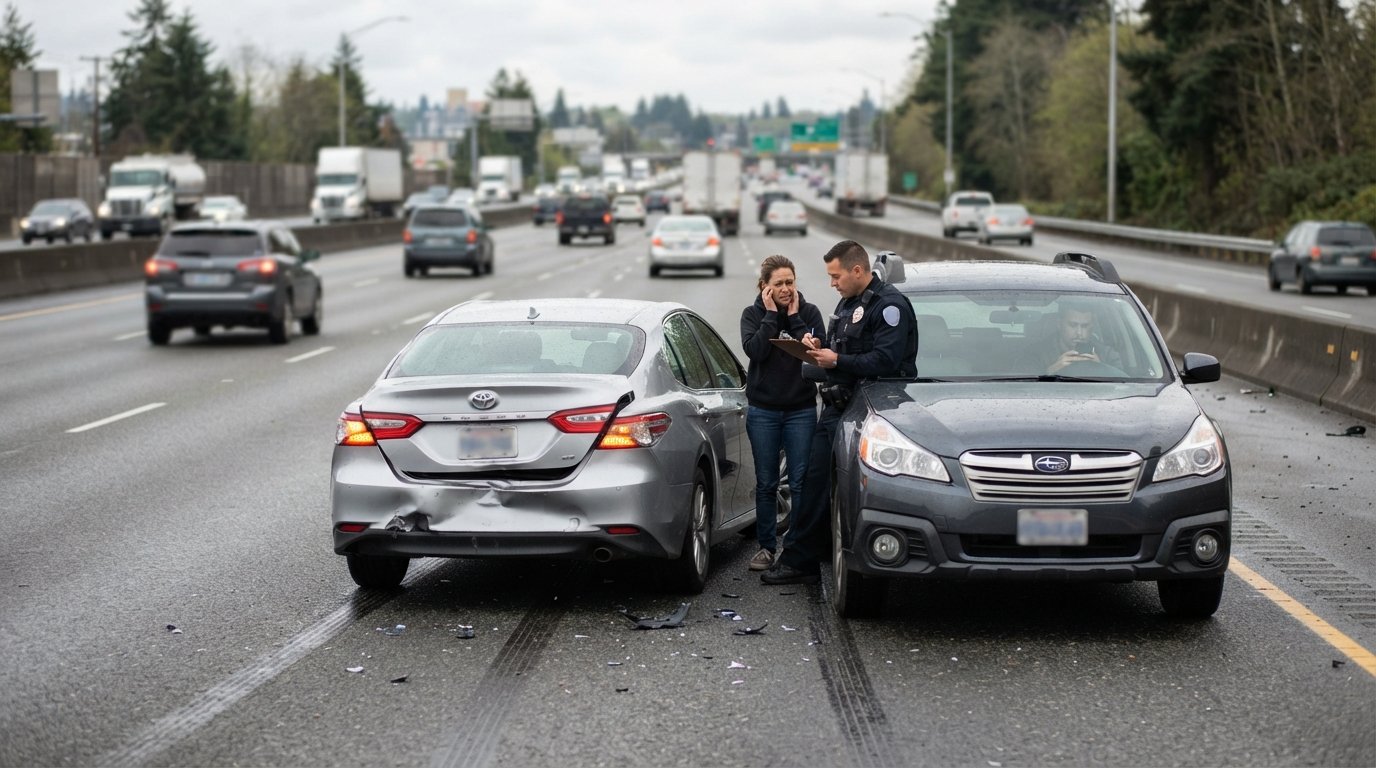
Rear End Collision Fault Rules: Proving Driver Distraction
Rear end collision fault rules and how to prove the other driver was distracted: build a winning case with phone records and more. Call (833)-632-1198 for a free review.

Your hands are still shaking on the steering wheel when the other driver walks up and says, "Sorry, I wasn't paying attention." Then the police report arrives and lists you as the at-fault party simply because you were in front. That reversal, where the rear driver's admission of distraction gets buried under a generic fault presumption, is one of the most frustrating scenarios in car accident law. The good news is that rear end collision fault rules are not absolute, and proving the other driver was distracted is a matter of evidence, timing, and knowing which legal levers to pull. This guide walks you through the presumptions, the exceptions, the specific evidence that wins these cases, and the point at which a lawyer's subpoena power becomes the difference between a denied claim and a fair settlement.
Why Rear Drivers Are Usually Presumed at Fault
The default rule in nearly every U.S. state is that a driver who strikes a vehicle from behind is presumed negligent. The reasoning is straightforward: a driver paying attention should be able to stop in time. Courts and insurers lean on the doctrine of res ipsa loquitur (the thing speaks for itself) and on following-distance statutes that require drivers to maintain enough space to stop safely. When you are rear-ended, the burden initially falls on the rear driver to explain why the collision was not their fault.
That presumption shapes everything that follows. Insurance adjusters open a rear-end claim assuming the rear driver is liable, and they will resist paying anything to that driver unless the evidence is overwhelming. For the front driver, the presumption is a hurdle but not a wall. It can be overcome with evidence that the rear driver was distracted, speeding, impaired, or that the front driver did something unexpected and unlawful.
It also matters how your state treats fault. In traditional fault states, you can recover from the at-fault driver's insurer, but if you share some blame, your recovery is reduced by your percentage of fault. In no-fault states, your own personal injury protection (PIP) coverage pays first regardless of who caused the crash, though fault still matters for serious injuries and property damage. For a deeper look at how these systems interact, see our guide on how no fault insurance systems work. Either way, proving the other driver was distracted strengthens your position, whether you are negotiating with an adjuster or pushing back against a fault determination.
Exceptions That Shift Fault to the Front Driver
The rear-driver presumption is rebuttable, and there are well-recognized scenarios where the front driver can be found partially or fully at fault. The most common is the sudden stop. If you slammed on your brakes without a valid reason, such as a red light, a pedestrian, or an obstacle, the rear driver may argue that no reasonable following distance could have prevented the crash.
Brake checking is a related but more serious allegation. If the front driver intentionally tapped or slammed the brakes to send a message, that conduct can be characterized as aggressive driving or even fraud in staged-accident cases. Proving brake checking requires physical evidence, witness testimony, or dashcam footage, because the rear driver bears the burden of showing the front driver acted intentionally or unreasonably.
Other exceptions include:
- A sudden lane change or merge that cut off the rear driver and left no stopping distance.
- A vehicle that was stopped in a travel lane without lights, reflectors, or warning triangles.
- A front driver who reversed unexpectedly into the vehicle behind.
- A mechanical failure that caused the front vehicle to stop without brake lights.
Each of these defenses shifts the analysis from "the rear driver was following too closely" to "the front driver created an unavoidable hazard." If the rear driver was also distracted, however, that distraction usually neutralizes the defense. A driver who was texting has a hard time arguing that even a perfect following distance would not have helped, because a distracted driver's reaction time is demonstrably slower.
The Evidence That Proves Distraction After a Rear End Collision
Distraction is rarely admitted at the scene unless the other driver volunteers it. More often, you have to build the case from records. The strongest evidence categories in a rear-end distraction claim are phone records, telematics data, witness testimony, and visual evidence such as dashcam or surveillance footage. Each has strengths and limitations, and the best cases combine several of them.
Phone records are the gold standard when the other driver was on a call or texting. A subpoena can obtain call detail records showing incoming and outgoing calls and text message timestamps. The content of text messages is harder to obtain and often protected, but metadata showing that a message was sent or received in the moments before impact can be enough. Telematics data from the vehicle, or from a mobile app, can show speed, braking, and acceleration in the seconds before the crash. Witness testimony from passengers, other drivers, or pedestrians can describe seeing the driver looking down at a phone. Dashcam footage from your own vehicle or a nearby business can capture the moment of impact and the driver's posture.
The following framework helps organize the evidence-gathering process:
- Preserve the scene evidence immediately. Photograph all vehicles, skid marks, debris, and the other driver's dashboard, including any visible phone mounts or screens.
- Get the police report and supplement it. If the officer did not note distraction, provide a written statement describing what you observed.
- Collect witness information at the scene. Names, phone numbers, and a quick note about what each witness saw.
- Send a spoliation letter to the other driver and insurer. This demands preservation of phone records, vehicle data, and dashcam footage before they are overwritten or deleted.
- Request your own vehicle's event data recorder (EDR) download. Many modern cars store pre-crash speed and braking data.
Timing is critical because phone companies and vehicle systems retain data for limited periods, and dashcam loops overwrite quickly. A spoliation letter puts the other side on notice that evidence must be preserved and creates a record if they fail to do so.
Documenting Distraction Without Crossing Privacy Lines
You cannot simply demand the other driver's phone and start scrolling. Privacy laws, including state wiretapping and electronic communication statutes, restrict how phone data can be obtained. The proper path is through legal process: a subpoena issued in a lawsuit or, in some states, a formal discovery request during the claims process. Your own documentation should focus on what you can lawfully observe and preserve.
At the scene, you can note whether the driver was holding a phone, whether a screen was glowing, whether the driver was eating, applying makeup, or reaching for something. You can photograph the interior of the other vehicle if it is visible from outside, but do not reach into the vehicle or take personal property. If a witness saw the driver looking down, get a written statement. If there is a business nearby with a security camera, ask the manager to preserve the footage and note the time window.
Social media posts can also be relevant, but they must be collected carefully. A public post showing the driver was active on social media shortly before the crash can support a distraction theory, but screenshots should be preserved with timestamps and metadata. Attempting to access private accounts or using deception to obtain information can create legal problems for your own case.
When a Lawyer Should Subpoena Evidence
There is a point in every rear-end distraction case where informal requests stop working. The other driver's insurer may refuse to turn over phone records voluntarily, or the phone company may require a subpoena. That is when a lawyer's subpoena power becomes essential. An attorney can issue subpoenas for call detail records, text message logs, telematics data, dashcam footage, and employment records if the driver was working at the time of the crash.
Lawyers also know how to frame the subpoena to survive privacy objections. For example, a subpoena for phone records can be limited to a narrow time window around the crash, which makes it more defensible. An attorney can also coordinate with accident reconstruction experts who can analyze EDR data and compare it to the driver's account. If the other driver was on a work call or using a company vehicle, the employer may be liable under respondeat superior, and a lawyer can pursue those records as well.
Knowing when to bring in a lawyer is part of the strategy. If the insurer has already denied your claim based on the rear-end presumption, if the other driver's story conflicts with the physical evidence, or if you have significant injuries, a consultation is warranted. A free case review can clarify whether subpoena power is needed and what evidence is still recoverable. For broader guidance on legal disputes involving attorneys and consumer rights, resources such as AttorneyLawsuit provide educational context on legal claims and professional accountability.
Building a Fault and Distraction Case That Holds Up
The strongest rear-end distraction cases are built on a clear timeline. Start with the moment before impact: what was the traffic flow, what was the weather, what was the distance between vehicles. Then layer in the other driver's behavior: was the vehicle drifting, was the driver's head down, was there a phone visible. Next, add the objective records: phone timestamps, EDR data, dashcam footage. Finally, connect the behavior to the crash through expert testimony or a common-sense explanation of reaction time.
Insurance adjusters respond to specificity. A demand letter that says "the other driver was distracted" is easy to reject. A demand letter that says "the other driver sent a text message at 4:17 p.m., the crash occurred at 4:18 p.m., and the EDR shows no braking until 0.3 seconds before impact" is much harder to dismiss. That level of detail often moves a claim from a denial to a settlement offer.
It also helps to understand the fault rules in your state. Some states apply pure comparative fault, where you can recover even if you are 90 percent at fault, while others apply modified comparative fault with a 50 or 51 percent bar. If you are in a no-fault state, the distraction evidence may matter less for your injury claim but more for property damage and any claim that exceeds the no-fault threshold. A local attorney can explain how these rules apply to your specific crash.
Finally, do not overlook the value of a prompt, organized file. Keep copies of the police report, medical records, photographs, witness statements, and all correspondence with insurers. If you later hire a lawyer, that file saves time and preserves evidence that might otherwise be lost. If you handle the claim yourself, the file demonstrates to the adjuster that you are serious and prepared.
Rear-end collisions are common, but they are not simple. The rear-driver presumption gives the other side an early advantage, and overcoming it requires evidence that is often in the hands of the other driver or a third party. By understanding the fault rules, documenting distraction lawfully, and knowing when to seek subpoena power, you can level the playing field and pursue the compensation you deserve.